
It’s impossible not to be concerned about artificial intelligence
We are in a period of generalized “hype” around artificial intelligence, especially everything that has to do with generative AI.
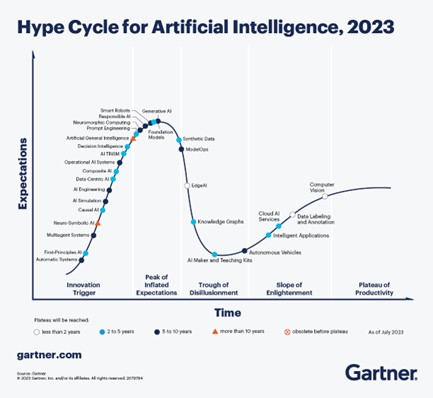
We are flooded with headlines about new AI models and daily demonstrations of their capabilities. Moreover, we can experience it firsthand, thanks to a wide range of tools at our disposal.
In this context, new words appear such as “AInxiety” (AI-related anxiety) and the “FOBO” (Fear of Becoming Obsolete or the fear of obsolescence). This anxiety and this fear It affects both organizations and, more individually, the workers who are part of them.
It’s normal to start running towards AI, but In this rush, it is easy for us to stop reflecting on how we want to relate to AI.
Adopt or adapt to artificial intelligence?
The philosopher Josep Maria Squirol in his latest book he states that “no matter how powerful it is a technology and however much it tends to become a system, the key is to adopt it and not adapt to it” Adapting to a technology, in this case artificial intelligence, is “becoming a proletarian and servant of an impersonal system”. In other words it means that we accept, without too much critical thinking and ignoring some important questions, technology in the form and conditions that are presented to us presents as inevitable. With AI and the whole avalanche of new developments and tools, it is very difficult not to fall into the trap of rushing to adapt to technology.
Adopt a technology is “to maintain oneself as the author of the construction of the world”. In other words take responsibility for guiding the form and conditions of technology deployment in society. A responsibility that must be exercised as individuals, as organizations and, through the public sector, as society as a whole.
The goal we should pursue, with AI and with any technology, is to ensure that technological advances lead to widespread social progress.
Aina Project, a public, transparent, responsible and open artificial intelligence
When we want go further by doing some demonstrations and a press release, we will have to do some questions in aspects such as:
- The performance of the AI system in Catalan, what is known as “AI language gap“. This language (and cultural) gap affects the quality of results and also the security of AI models when our product or service is not presented in global languages such as English or Spanish.
- The privacy of our data and the data of the users of our systems. In many of the tools there are reasonable doubts on privacy issues. The terms and conditions, if we read and understand them, we will not be able to negotiate them either. For all of it several companies prohibit the use of certain AI tools. The best option is to be able to download the models and carry out operations in a secure environment that we have control over.
- Compliance with AI Act regulations in aspects such as the transparency about the training data of AI models or the ability to explain (explainability) the internal mechanisms of AI-based automated decision systems.

SOURCE: https://crfm.stanford.edu/2023/06/15/eu-ai-act.html
- The real cost of AI, thinking a few years ahead and thinking about adjusting the AI model with our data in order to improve its predictive capacity. Here we have to think about the development costs and also the deployment costs (model inference) with a balance between the size of the models and the accuracy of the results. In economic terms we are interested in have smaller models that can be adjusted to our context.
To help provide good answers to some of these challenges, that is, in order to be able adopt AI in a responsible and controlled manner at the end of 2020 was born the Aina project.
The Aina project, led by the Government of the Generalitat of Catalonia and developed within the Language Technologies Unit of the Barcelona Supercomputing Center (BSC), provides the Catalan language from the open infrastructure needed (text and audio corpora, prepared AI models, instructions, evaluation datasets, etc.) to ensure the development of applications based on AI and language technologies (AI/LT).
Source: https://projecteaina.cat/tech/corporatiu/
The Aina Project is an example of what a public artificial intelligence (with a focus on language and the development of the local technology sector), transparent (regarding data and training processes), responsible (working to ensure compliance with the AI Act and facilitating the evaluation of models) and open (with permissive open licenses and with the resources available in a way open and free to HuggingFace and other repositories) We encourage you to consult resources from Aina project
- Visiting the website https://projecteaina.cat/
- Following the X/Twitter account https://twitter.com/projecte_aina
- Reviewing the contents of the Aina Kit – https://www.bsc.es/AinaKit
- And signing up for the Aina Challenge – https://ainachallenge.cat/
To stay up to date and know how to integrate Aina’s resources into your AI/TL projects.
Within the framework of the Catalonia.AI strategy the CIDAI and BSC collaborate closely to facilitate the technology transfer of the Aina project. We would be delighted if you could send us the your questions and suggestions in order to improve the accompaniment on this journey.
